The Turning Season: Winter to Spring at Hattingley Valley
After months of stillness in the vineyards and even a fleeting dusting of snow across our Hampshire hills, the first signs of movement are returning to Hattingley Valley. Spring doesn’t arrive all at once here; it begins quietly with the first snip of secateurs down the rows.
The Vineyard Wakes: Pruning Begins

After winter strips the vines back to their bare essentials, everything is visible: structure, strength, and the decisions made years before.
A few weeks ago we began the first major step in shaping the 2026 vintage, as pruning began at our Chalky Hill and New Site vineyards. Working predominantly with a single Guyot system, canes are chosen not just for this year’s growth, but to build a healthy framework for seasons to come.
We begin by selecting a healthy, pencil-thick cane from the previous season’s growth to become the new fruiting arm. Last year’s fruited horizontal arm is then fully removed, allowing the vine to focus its energy on fresh growth. A few strong lower shoots are cut back to two or three buds to form the renewal spur, essential for choosing next year’s canes and maintaining the vine’s structure.
The chosen fruiting cane is trimmed to around 60–90cm (approximately eight to ten buds), carefully balanced for quality and yield, before it will in a few weeks time, be gently bent and tied to the lower trellis wire to encourage even bud break.
Under the guidance of Vineyard Manager Colin Hayward, and occasionally dodging the recent drizzle, our experienced volunteers have recently completed this first essential pruning of the year.
Inside the Winery: Where the Quiet Work Continues

While activity resumes outdoors, inside the winery, the pace is also picking up.
Spring is a time of base wine sampling, tank management and one of the most creative (and critical) processes in traditional method winemaking: blending and bottling. Harvest may often take the spotlight for one of the largest jobs of the year, but blending and bottling marks the true close of our production year here at the winery.
The Art of Blending

Over weeks of careful tasting, discussion and refinement, our winemaking team evaluates individual base wines, considering structure, acidity, aromatics and texture before composing the final cuvées. It’s an important step in achieving balance and preserving our Hattingley house style.
Spring tasting sessions are focused and thoughtful. Small adjustments can make a profound difference years down the line, once the wine has matured on lees. It’s meticulous work, but also one of the most exciting parts of the year for our team.
Bottling the 2025 Vintage
 In April and June, the bottling line will arrive, a serpentine production line, where glass bottles are placed on a conveyor belt, and the blended base wine is bottled with a precise addition of wine, yeast and sugar, and sealed with a crown cap.
This addition of wine, sugar and yeast is called the Liqueur de tirage, and it initiates the crucial second fermentation inside the bottle. This is where the transformation happens. Carbon dioxide is naturally created, forming the fine, elegant bubbles that define traditional method sparkling wine.
From there, the bottles are transferred to rest quietly on their lees (dead yeast cells) for many years to come. During this time, complexity deepens, texture softens, and the wines slowly evolve into the finished articles our customers know and love.
New Releases and Upcoming Vintages
Spring is not only a time for preparation but also a season of anticipation. While new wines begin their journey in bottle, others are nearly ready to meet the world.
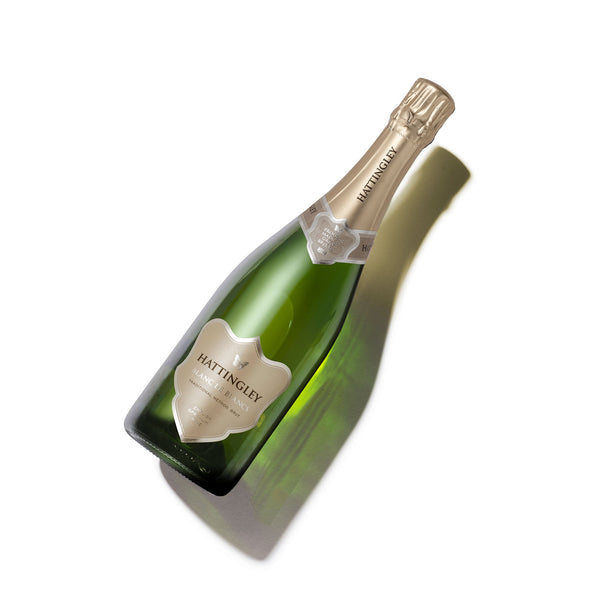
Blanc de Blancs 2019
 Our new Blanc de Blancs 2019 vintage released this month is the ultimate chef’s choice wine. Blanc de Blancs 2019 is pale gold with a fine, delicate mousse. Aromas of apple blossom, crisp lemon and English pear lead into citrus zest on the palate. Honeydew melon, smooth almonds and the tangy richness of key lime pie add depth and generosity, finishing with a full body and beautifully clean precision.
With this wine, the pairings are endless, but one of our favourites is with delicate fish, like seabass in a white sauce or delicious smoked trout pate (of course, we think Hampshire chalk stream is best!).
Entice 2025
 Arriving Easter 2026, Entice 2025 is a vintage with a new look. Presented in an elegant Sauternes-shaped bottle and finished with a screw cap for easy opening and resealing, we are excited for Entice enthusiasts to experience both the refreshed design and the new release.
The move to a screw cap marks a considered step forward for this wine. Offering a more oxygen-tight seal, which not only safeguards the wine against oxygenation, but also means it can be stored in the fridge for up to two weeks after opening, maintaining its freshness and vibrancy. If you’d like to learn more about how it’s made, you can read our blog: The Legend of Entice: How Our English Dessert Wine Came To Be.
In the glass, Entice 2025 is wonderfully expressive. The nose is aromatic, with pronounced notes of tropical fruit, lychee, ripe peach and blossom. On the palate, flavours of cooked pineapple, mangosteen and lemon curd unfold, creating a luscious, richly textured wine with a long finish. A vintage we very much look forward to sharing.
A Season Defined by Intent
At Hattingley, Spring is an important season, where pruning shapes the vineyard’s structure, blending establishes each wine’s character, and bottling sets the stage for maturation to come.
Here's to the wines just beginning their journey, and those newly ready to be enjoyed.